
Diasporic Coinages: The Curious Case of 'Caribbeans' and Local Community Backlash
Much to the chagrin of West Indians living in the region, the proliferation of identity label 'Caribbeans' across social media almost entirely by folks raised abroad has stirred up some bacchanal.

There are few ways to unite the Caribbean. Despite the immense diversity of the region, as well as our shared histories of European colonisation, we are somehow always feuding with one another. Who has the best version of Carnival? Whose accent is the sweetest? Reggae and dancehall versus soca calypso, which one is the nicest? Are Guyana and Suriname considered Caribbean? It seems every year the flames of discord are fanned and social media has done nothing to put out the fire. But one topic has seemingly banded together West Indian people, particularly those online, against their foreign born and/or raised community members. In just the past couple of years, the identity label Caribbeans has increased rapidly in usage both digitally and in-person by those with Caribbean heritage born in or having resided for most of their lives in the United States, Canada, and United Kingdom where the bulk of the diaspora can be found. While the Caribbean American, Caribbean Canadian, and British Caribbean communities are certainly not in agreement over the term, since younger folks are the main users, it has been rejected outright by those who roots remain planted in the homeland. The inclusion of an ‘s’ to the end of Caribbean has almost become a litmus test for one’s cultural authenticity, making those in favour of this coinage subject to jesting from fellow kin. When you add to this disagreement the fact that being in North America and Europe gives one more access to international media outlets, individuals in the West Indies are often annoyed to see a term they despise printed in newspapers and magazines or endorsed by platforms whose audience spans far and wide across the world. So where did Caribbeans comes from and what should we do about it?


Just as a disclaimer from the editor, The Cutlass Magazine is not in favour of this modern linguistic invention. Drawing on childhood experiences, it was common to say “I am Caribbean” and “We are Caribbean”. There was no ‘s’ in sight even a decade ago. One supposed theory for Caribbeans is the fact that being geographically distanced from the West Indies also means displacement from regional parlance. Collisions between Creole and American, Canadian, and British dialects is bound to yield archaic retentions due to the vernaculars of first generation parents and grandparents being a sort of time capsule of what was spoken at the point of their departures. Their speech is the most immediate reference for foreign born and/or raised offspring who may hold on to words and phrases no longer in vogue amongst generational counterparts in the West Indies. But at the other end of the spectrum such intermixing is going to lead to mispronunciations and creations. Caribbeans appears to fall in the latter category. In the age of social media, one instance of the term in usage by an influencer in their post is the single ember sometimes needed in order to legitimise the label for the community.


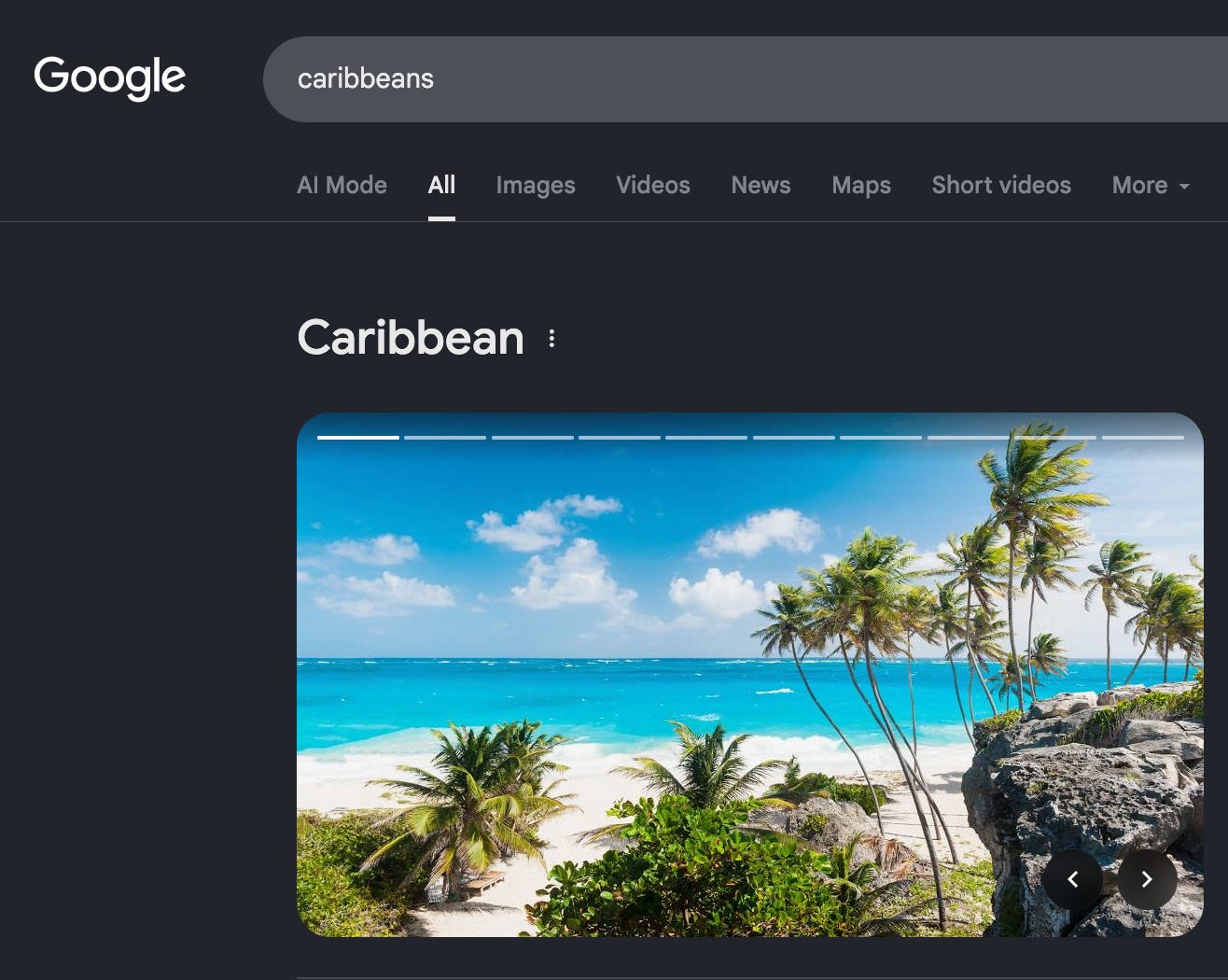
There is maybe no point in trying to advocate for or against deriving Caribbeans from Caribbean on a grammatical level. If we take into consideration other markers that end with -n, the ones at the top of mind: Pakistan, Afghanistan, Sudan, Japan, Bhutan, Lebanon, Yemen, Oman, Jordan, and Iran. If you examine their demonyms: Pakistani, Afghan, Sudanese, Japanese, Bhutanese, Lebanese, Yemeni, Omani, Jordanian, and Iranian. Demonym is an adjective used to refer to a person from a particular nation or area. While some are pluralised from person to people (i.e. Afghans, Iranians, Jordanians) they are not directly pluralised from place to people in the way Caribbean and Caribbeans are. Yet Caribbean is also distinct because it is a regional marker not a national one. Much in the same way you cannot pluralise Latin (referring to people from Latin America) into Latins. Other regional labels are not coined with that relationship. Middle East becomes Middle Eastern and West Indies yields West Indian. Britain, consisting of the countries England, Scotland, and Wales; is denoted as British. Regions ending in -a have an -n tacked on the end (i.e. America to American, Africa to African, Asia to Asian, Australia to Australian). If you look up the terms above in a search engine they all do exist, with the exception of Caribbeans for which the results revert back to Caribbean.
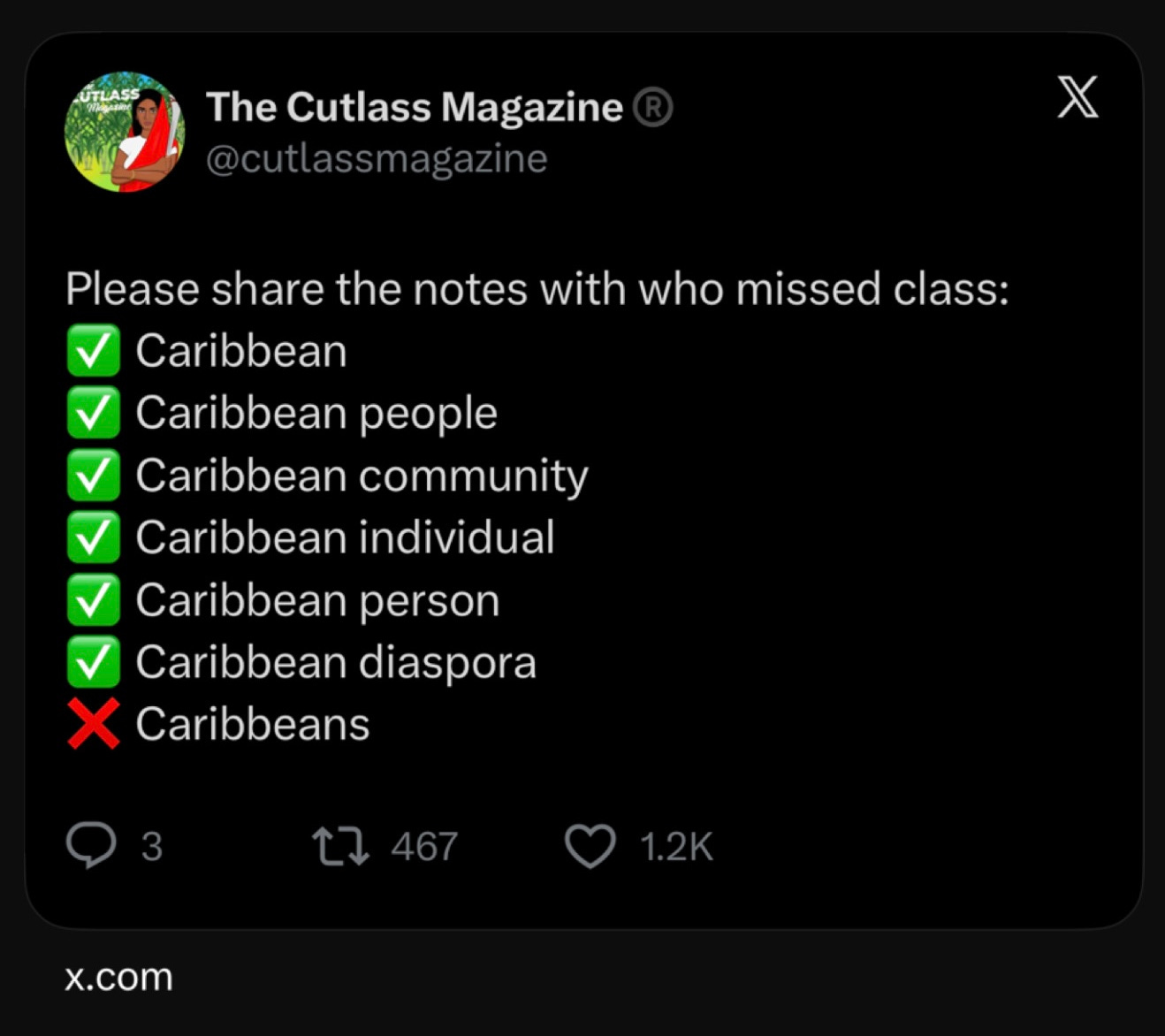
‘Language prescriptivism’ is the process of defining what is correct and proper in a language. These rules are usually designed to suggest how persons should communicate, sometimes at odds with how they actually communicate. Such approaches to speech are criticised for overstandardising languages. But if you note existing turns of speech such as “chai tea” or “naan bread,” those are often made fun of due to the redundancy. The second word is a synonym of the first and therefore it is unnecessary. Similarly, there is no need for “roti skins” or “roti shells” (another advent in both the Caribbean and diaspora) since “roti” is a standalone meal and there is no need for clarification when it is prepared or eaten without a filling or side dish. “Skins” and “shells” are both unwarranted qualifiers. Using logic from the above examples, Latins included, there is no void left by Caribbean for Caribbeans to fill. Caribbean, Caribbean people, Caribbean persons, Caribbean individuals, Caribbean community, Caribbean diaspora, Caribbean folks; these are already in rotation and make Caribbeans dispensable.


Whether or not a Caribbean-descended person ‘living foreign’ utilises Caribbeans, and by extension Afro-Caribbeans or Indo-Caribbeans, has become a method by which their ‘Caribbean card’ may be revoked by individuals based ‘back home’. Of course diasporic and homeland identities evolve both in parallel and independent from one another, geographically distinct but culturally inextricable, as one label can be applied to encapsulate two groups. Maybe the most immediate comparison to how locals react negatively to Caribbean versus Caribbeans is how they feel about the usage of ‘Barbadian’ when Bajan is standardised regionally as the demonym for anyone from the island of Barbados. We all know language is complex and nonsensical, especially when it applies to English. Language is also ever changing. Trying to stop this evolution, and in some cases devolution, is almost impossible. But as Caribbeans is still in an early nascent stage of development, a discussion about its merits and those who have grievances with its existence is definitely justified. What are your thoughts on this topic?
Maybe they think that we come from Caribbee. So, if people from the West Indies are West Indians, we must be Caribbeans. This may turn into a chicken curry-curry chicken kind of discussion. Excuse my silliness but I couldn’t resist. This is a great read, Vinay. Well done! Looking forward to a good discussion here.