
Indo-Caribbean Sikhs: The West Indian Punjabi Community's Origins and Cultural Struggles.
From indentured labourers to Panama Canal workers, military men to independence rebels, the complex history of Punjabi and Sikh migration to the Caribbean has largely been passed down orally.


There are some generalisations made about the lineage of Indo-Caribbean community. You often hear that 85 percent of Indian indentured labourers came from North India, namely the states of Uttar Pradesh and Bihar, while 15 percent hail from South India, predominantly Tamil Naidu. The former departed from Calcutta Port while the later boarded ships at the Madras Port. It should be noted at the time Tamil Naidu was part of the Madras Presidency, Calcutta now Kolkata was in the Bengal Presidency prior to the partition into West Bengal and East Pakistan later Bangladesh. Uttar Pradesh was also formerly referred to as the United Providences. Another broad statistic is roughly 85 percent of our ancestors were Hindu and 15 percent Muslim. These notions exist because they are indeed based in facts. The majority of those who came from the subcontinent were North Indian Hindus. Significant minorities were Bangla or Bengali-speaking Bengalis, Madrassis not just from Tamilian backgrounds but Telugu (Andhra Pradesh) and Malayali (Kerala) heritage as well. When you look into the even finer details of the folks considered to be bound coolies, however, there are some fascinating outliers. Marathi, Nepali, Rajasthani, and Gujarati folks in some cases. But did you know that there were Punjabis who found themselves in the West Indies and Indo-Caribbean Sikhs alive today who are a testament to their legacy? Punjabi films, bhangra music, that is not the extent of the Indo-Caribbean relationship with Punjab and the Sikh community. For the record, Punjabi and Sikh are not synonymous. But this post is specifically examining Punjabi Sikhs in the Caribbean.

Sikhism was founded by Guru Nanak, who lived from 1469 to 1539, in the late fifteenth century. The movement took root in his native land of Punjab in North Indian and his message of Ik Onkar (“One God”) who represents the eternal truth and resides in every living being attracted Hindu and Muslim converts in the region. Guru-Ji’s teachings are recorded as shabda or hymns in the Sikh holy book known as the Guru Granth Sahib, a name shared with the sacred text of the Shivnarayan Panth written by Swami Shiv Narayan from Uttar Pradesh. Following in Guru Nanak’s footsteps were nine successive human gurus: Guru Angad, Guru Amar, Guru Ram Das, Guru Arjan, Guru Hargobind, Guru Har Rai, Guru Har Krishan, Guru Teg Bahadur, and Guru Gobind Singh. The teachings and songs from several of them were added to the scripture, along with the words of several Hindu saints (i.e. Kabir, Ramananda, Namdev) and Sufi mystic Sheikh Farid. These various guides and renditions of the text propagated the Sikh over the course of two centuries before the Guru Granth Sahib was at last consecrated as the eleventh, final, and eternal guru by Guru Gobind Singh (the tenth) in 1708. Today there are an estimated 30 million Sikhs worldwide, collectively known as the Sikh Panth. The vast majority, but not all, are of Punjabi background and belong to the Rajput or Khatri caste of warriors. Some couple hundred of them are found in the Caribbean, mainly Trinidad and Tobago.
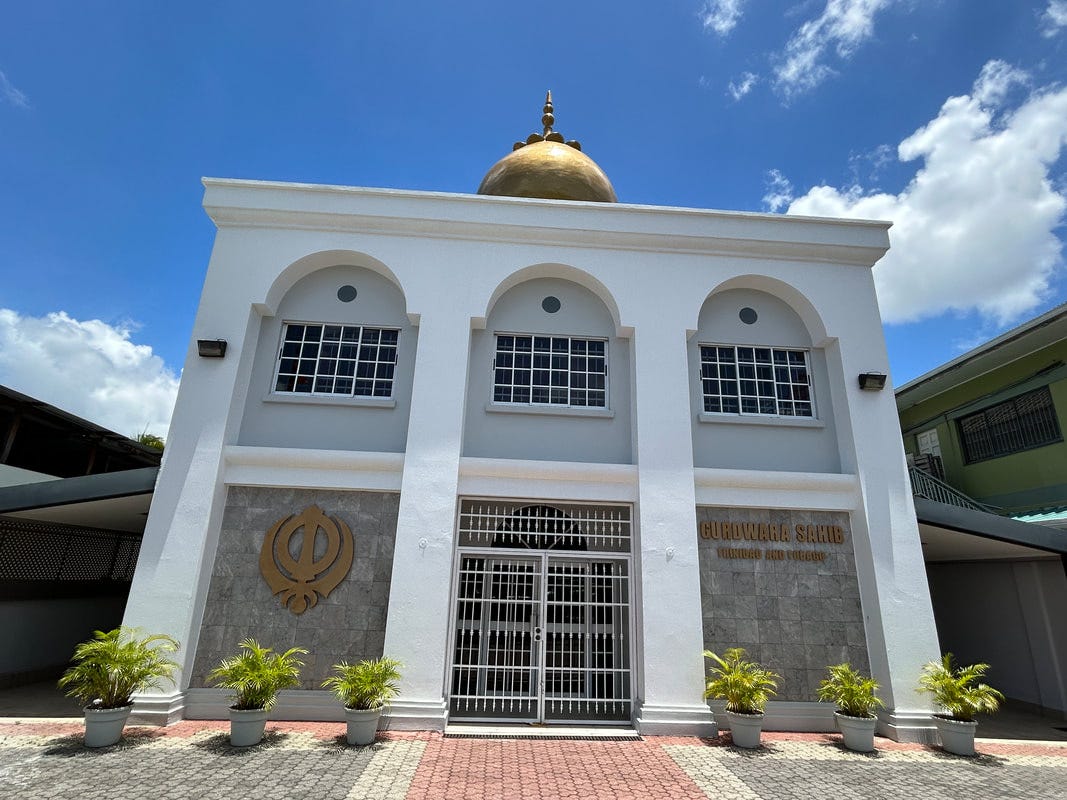
The Gurdwara Sahib located in El Dorado, Trinidad and Tobago is the second oldest Sikh house of worship found in the western hemisphere and remains the only Sikh institution in the Caribbean. The name stems from “guru” meaning guide and “dwaar” for home or abode. Punjabi migration to the twin island nation has quite a complicated history. There are those who arrived in the middle to late 1800s because they were rebels involved in riots in India, namely the Indian Mutiny of 1857, and fled retaliatory punishment from the British. Select few were indentured labourers whose origins can be traced back to the parts of Punjab such as Ludhiana. Some Sikhs went abroad as labourers on the Panama Canal or to be merchants and shopkeers in Kenya and Uganda but found later themselves in Trinidad in the early to mid-1900s due to economic and/or political instability elsewhere. Others are said to have come to the West Indies while enlisted in the Indian army but still under the control of the Queen and government of England. Much of this lore has been passed down orally in families.

Members of the first generation from India to land in Trinidad included Hemraj Singh (circa 1880), Sher Singh (circa 1890), and Karam Singh (circa 1930). Many of them were lone male travelers, most unmarried but some whose wives remained in the subcontinent, and married the local Trinidadian Hindu women. Sikh men bear the title of Singh translating to “lion” due to their caste based identity as soldiers, warriors, and guardians so the aforementioned individuals are not blood related. Despite that, they found solace amongst each another and at the gurudwara established in the late 1800s or early 1900s by Hemraj Singh. His brother Hardit Singh founded local spice factory Turban Brand in 1925 and remained in operation for 85 years, manufacturing curry powder and masala, until 2011 when it was purchased by rival brand Chief. As the name suggests, the logo of the Turban Brand was a bearded Sikh. Most Trinidadians, despite using the products for years, do not know the backstory.

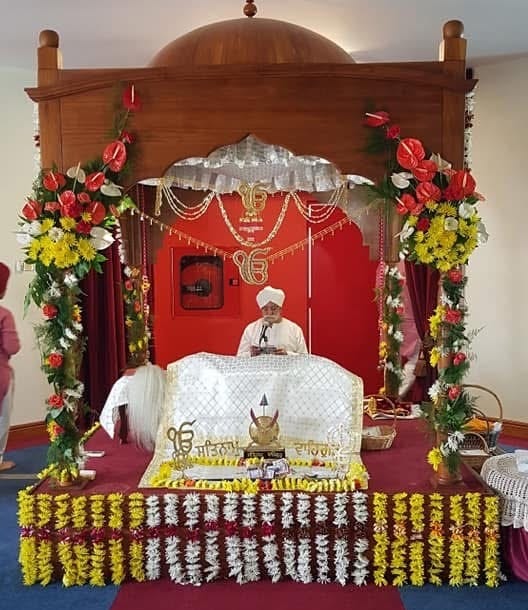
The modest wooden structure built by Hemraj Singh was replaced in 2004, on the very same site, with the one pictured below. It was designed by renowned architect Sri Jaspal Bhopal, Kenyan-born Punjabi and over five decade resident of Trinidad and Tobago. The construction was financed by Trinidad-based businessmen Abtar Singh Malli of Malaysia and Gurbal Sandhu of Singapore, also of Punjabi Sikh heritage. Malli pursued employment in Trinidad after studying in Canada; opening up Discount Gold Mine in 1991, Gold Mine Jewellers in 1992, and City Jewellers in 1994. Sandhu, an industrialist, was educated in Canada too. The gurudwara adheres to the core principles of Sikhism. It is open to all, the vegetarian langar (community kitchen) meal is served free to everyone, young Trinidadian Sikhs are initiated into the faith by taking amrit, couples have an Anand Karaj (Union of Bliss) wedding ceremony performed on the premises, kirtan singing of traditional hymns is done, a single saffron-coloured jhandi (flag) called the Nishan Sahib (a powerful mark of Sikh identity) is hoisted up on the property, and sacred holidays such as Lodi and Vaisakhi are observed. Service takes place every Sunday morning. In recent decades the population of Sikhs in Trinidad has expanded due to the advent of the Mahatma Gandhi Institute, Indian High Commission, diplomatic links between India and Trinidad, as well as education and employment opportunities offered through both the University of the West Indies (UWI) and University of Trinidad and Tobago (UTT).
Today the gurudwara sangati or congregation constitute a mixture of Trinbagonians and Punjabi expatriates. Some of the regular musicians in attendence include singers Sangeeta Jagdeo and Varuna Parsan, students of the late Professor Hari Shanker (H.S.) Adesh (1936-2021). Adesh left India in 1966 and established the Bharatiya Vidya Sansthhaan school of Hindustani classical music in San Juan, Trinidad. It has continued training artistes to this day for some six decades now. Descendants of the original Punjabi emigrants to the nation, despite sometimes marrying non-Sikhs, have carried the traditions forward. They bear names such as Kumarsingh, Umraosingh, Harditsingh, Shersingh, etc. There remains confusion in the Indo-Caribbean community about whether Singh is a distinctly Punjabi and/or Sikh surname. Two main categories of Singhs exist, those from Punjab as discussed but also folks who belong to Uttar Pradesh and Bihar. The second group are from the Chatri caste, the Bihari name equivalent of Rajput and Khatri. Those Singhs are Bhojpuri and Awadhi-speaking Hindus, whose practices center on readings of the Holy Ramayan as well as Hanuman Puja. The overwhelming bulk of Indo-Caribbean individuals with the name Singh belong to this lineage.

Waheguru-Ji. Sat Sri Akal.